Choosing the Right Marketing Channels: How to Get It Right from Strategy to Selection

Channel choice isn’t about ticking boxes or spreading budget evenly. It’s about knowing exactly what you want to achieve, who you need to reach, and how each channel can deliver against those goals. Without that clarity, your campaign risks looking busy but doing very little.

Let’s break down the factors that really matter when deciding where your media dollars go.

Part 1: Always Start with Strategy

GOALS

Before you touch a media plan, align on business, marketing, and sales goals.

  • Business goals – Where is the company heading this quarter, this year, in three years? Growth targets, expansion plans, market share objectives – they all dictate how ambitious your marketing can be.
  • Marketing goals – Are you building brand awareness, improving salience, driving trial, or pushing for loyalty?
  • Sales goals – What revenue shifts do you need? Which products or services are the priority?

AUDIENCE

If your audience definition is fuzzy, your channel choices will be too.

Definition – Be specific. Who are they, what do they think, what do they value, and what gets in the way of them buying from you?

Needs – Are they looking for information, reassurance, inspiration, or a deal?

Research – What’s proven? Where are the gaps? Invest in data or research that plugs those holes.

Segmentation – Are you talking to one homogenous group or multiple micro segments with distinct needs?

Targeting – Focus on the segments that give you the most impact for your spend – and be clear on who you’ll exclude.

Consumption habits – What do they consume, when, where, and for how long? That insight will steer you away from channels that won’t stick.

CONTENT

Even the perfect channel mix will fail if your content doesn’t land.

  • Positioning – Does your brand have a clear, consistent perception in-market?
  • Competitors – Who’s dominating in your space and how? What messages are they winning with?
  • Value proposition – Is your offer a product push, a service proposition, or a brand story?
  • Messaging – Tailor it to fit each channel’s format, tone, and audience expectations.
  • Offer – Ensure every touchpoint has a clear, appropriate call to action.
  • Cohesion – Your channels should complement each other. Mixed messages dilute impact
  • Creative – It needs to stand out and not blend in as ‘noise’. 

BUDGET

Budgets dictate not just how far your campaign can go, but also how it’s structured.

  • Short vs long-term – Are you making a big splash now or building slowly over time?
  • Brand vs product/service – Decide the weighting between brand-building and sales activation.
  • Phases – Will it be bursts, always-on, or seasonal?
  • Event-based – Are you leveraging a key date, product launch, or industry moment?

CHANNELS

Before choosing, interrogate each one:

  • Evaluation and suitability – Does it bring your proposition to life in a way that matters?
  • Engagement levels – Can it reach and hold attention, and to what extent?
  • Relevance – Where does it fit in the buyer journey? Is it part of the story or a disruption?
  • Share of voice – Can you afford enough presence in that channel to shift perception or behaviour?
  • Single vs multi-channel? – Multi-channel always!
multi-channels

Analysis & Optimisation

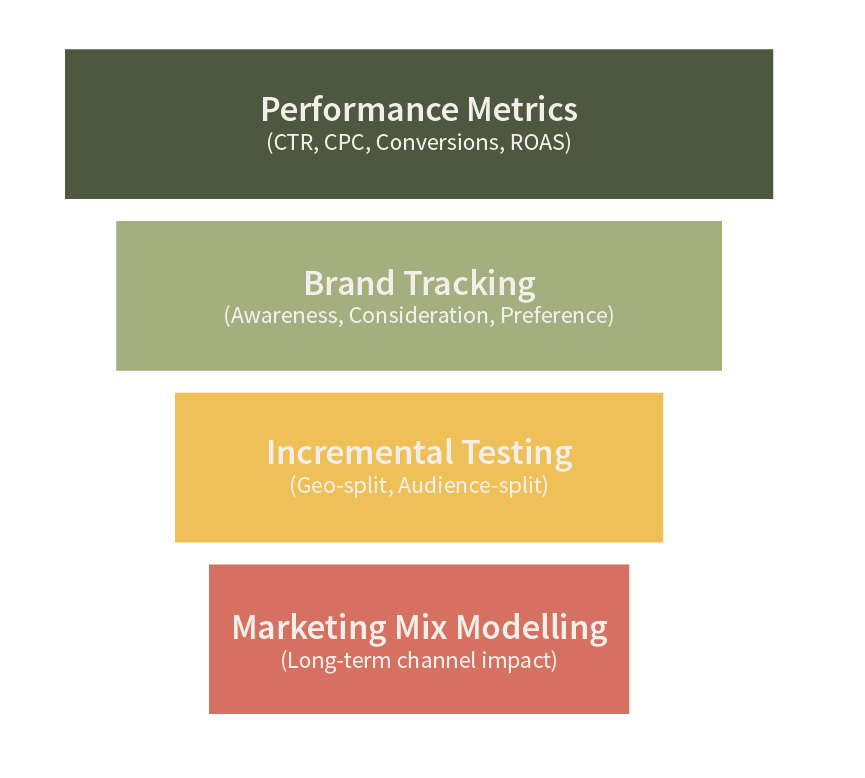
The right measurement is as important as the right media. Set up your reporting at the start so everyone on the team knows how success will be tracked and agreed. If you leave measurement as an afterthought, you’ll default to easy vanity metrics (clicks, likes, impressions).

HERE'S HOW TO THINK ABOUT IT:

  1. Performance Metrics
    These are your short-term indicators — CTR, CPC, conversions, ROAS. They’re useful for optimisation in real time, but they only tell you what’s happening at the bottom of the funnel. Relying solely on these can create tunnel vision, where you end up “harvesting demand” without creating any.

  2. Brand Tracking
    This is about measuring shifts in salience, awareness, consideration, and preference. Tracking brand health over time tells you whether campaigns are building the foundations for future growth. Tools like Tracksuit, YouGov, or bespoke brand trackers can show how your investment is moving the needle beyond immediate clicks.

  3. Marketing Mix Modelling (MMM)
    MMM gives you the long-term, holistic view. It looks across multiple channels and isolates their contribution to sales. While it’s more resource-intensive (and warrants a larger investment than brand tracking tools), it’s one of the most reliable ways to prove marketing’s impact to the board and CFO. As privacy changes reduce access to granular digital tracking, MMM is making a serious comeback.

  4. Incrementality Testing
    For more agile brands, incrementality testing (e.g., geo-split or audience-split tests) is a smart way to measure the true lift of a campaign or channel. It helps you understand whether spend is driving new demand or simply capturing what you would have won anyway.

  5. Balance and Integration
    The strongest measurement frameworks don’t pick one approach; they blend them:
    - Performance metrics to optimise in-flight.
    - Brand tracking to monitor audience impact.
    - MMM or incrementality testing to validate the big picture.

  6. Continuous Optimisation
    The “analysis” part is just the start. True optimisation means acting on the data: reallocating budget, refining creative, or shifting weight across channels based on what’s working. A good framework is living, not static.

Part 2: Choosing Channels That Work for Your Brand Type

performance-metrics
If you're a Start Up
start-up
Focus and speed win. With minimal resources, go for clarity over complexity. Use lean, test-and-learn media planning to identify high-leverage channels with the lowest cost of entry. Think paid social, SEM, digital video, and niche podcast buys – channels that give fast feedback and can be scaled if they work.
If you're a Challenger Brand
challenger-brand
Sharpen and scale. You’ve got traction, but now you need to optimise what’s working while increasing distinctiveness. Invest in campaign-based media with clear peaks in visibility. This could mean layering CTV with OOH in key locations, using digital audio for frequency, and precision-targeted paid search to close the loop.
If you're an Established Brand
established-brand
Declutter and reignite. Simplify overcomplicated structures and cut redundant spend. Focus on fewer, bigger campaigns with unified creative across channels. Use your scale to own moments in high-reach channels like broadcast TV, premium DOOH, and large-format OOH – but integrate with digital channels to keep relevance high.

Channel Overview

To help you make sense of the multitude of options, here’s a list of the key media channels and how each compare in terms of reach and alignment to your goals:

CTV/Streaming TV – Strong for targeted reach with the emotional pull of video with 100% share of screen.

DOOH & OOH – Great for building awareness and reinforcing brand presence; flexible formats suit both broad and hyper-local targeting.

SEM – High intent, conversion-focused; ideal for harvesting demand but not creating it.

SMM (Paid Social) – Versatile, scalable, highly targetable; works across awareness, engagement, and conversion.

Digital Video – Impactful for storytelling; more affordable reach than TV with precise targeting.

Broadcast TV – Unmatched mass reach; better for brand building than short-term activation.

Broadcast Radio – Strong reach and frequency; good for tactical messaging and regional targeting.

Digital Audio – Highly targetable; builds frequency and engagement with minimal intrusion.

Podcasts – Niche targeting with deep audience engagement; ideal for relevance and trust-building.

Cinema – Captive audience; high impact for launches and brand storytelling.

Publishing (digital & print) – Authority and context; works well for thought leadership or high-consideration purchases.

Final Word

Choosing the right channels isn’t about chasing the newest shiny object or copying competitors. It’s about alignment – between your goals, your audience, your creative, and your budget. Get that right, and the channels almost choose themselves.
Cinema | HabitatM
Article written by:
David Ross
Stay connected.
Making Businesses Better
Level 2, 627 Chapel St, South Yarra VIC 3141 ABN: 667 871 276